Link: https://arxiv.org/abs/2401.00254
Introduction or Motivation
Introduce a novel token contextualization method, Dynamic Token Morphing (DTM)
- Token morphing is a process that links contextually similar tokens and aggregates them for coherent and comprehensive representations.
- encode the token-wise target representations and derive matching relations among to-kens through DTM.
- The merging process is performed for both tokens regarding the matching relation and aligning each morphed token with the corresponding morphed target tokens.
- The range of morphing can vary from a single token to the entire token, covering from token-wise to image-level representation learning.
- While there are many options, we simply opt for bipartite matching for morphing, achieving both efficiency and efficacy.
Spatial Inconsistency

- CLIP-B/16, 98 tokens for token aggregation from 196 total tokens
- spatial 정보가 깨진 상태에서 zero-shot or linear probing하는 경우 보다 spatial 정보를 지키는(with Token Aggregation)을 했을 때 성능이 오른다
- → 당연한게 아닐까? MIM’s reconstruction training이 아닌 classification에서 partial token을 제공할 때 token aggregation을 함으로써 중요한 부분 또는 context를 유지하는게 유리할거기 때문이다.
Spatial Inconsistency in Representation Learning
Assumption: the spatial inconsistency in the self-distillation signal could potentially diminish the quality of representations.
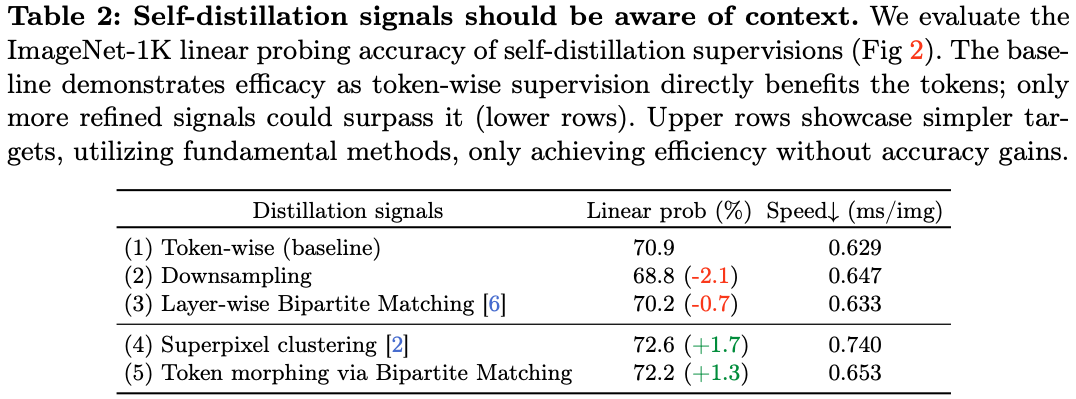
- Pre-train ViT-B/16 for 50 epochs and perform linear probing for 50 epochs on ImageNet-1K
- Token morphing outperforms that of the token-wise distillation approach
- bipartite matching and super-pixel clustering
Method - Dynamic Token Morphing
Definition:
- Contextually aggregate tokens to derive random numbers of morphed tokens aiming to encapsulate diversified semantic information.
Observations:
- Pre-trained models often produce noisy, spatial inconsistency token-level targets for learning
- Token aggregation methods could handle spatial inconsistency but are insufficient as a supervisory signal.
- a well-designed method is needed to consider context and reduce noise more effectively.
The core idea of DTM:
- The DTM module is straightforwardly added to the baseline MIM scheme.
- Token morphing function $\phi_R:\mathbf{R}^{N \times d} \rightarrow \{0,1\}^{\bar{n}\times N}$ based on morphing schedule $R$.
- calculates similarity using a matching algorithm like Bipartite Matching
- returns a token morphing matrix $M=[M_{ij}]\in\{0,1\}^{\bar{n}\times N}$
- $\bar{n}$: number of token groups after morphing
morphing numerous tokens enhances the denoising effect while morphing fewer tokens retains detailed token representations.
Since morphing a fixed number of tokens may benefit only one side, DTM balances these advantages by morphing a diverse range of tokens.
How to Dynamically Morphing?
- Dynamic Scheduler
- sample the final number of morphed tokens and iteration number
- $\bar{n} \sim \mathcal{U}(\bar{N}, N)$ from uniform distribution
- $\bar{N}$: minimum number of morphed tokens
- $\bar{k} \sim \mathcal{U}(1,K)$ from uniform distribution
- $K$: maximum number of iterations for sampling
- $\bar{n} \sim \mathcal{U}(\bar{N}, N)$ from uniform distribution
- $r_p$: sequence of token numbers that determines the number of tokens to morph for each iteration
- $R=\{r_p\}^k_{p=1} ~\text{and}~ \sum^{k}_{p=1}r_p=N-\bar{n}$
- sample the final number of morphed tokens and iteration number
- Token Morphing via Scheduler
- Split tokens into two groups, with each token in the first group matched to its closest cosine similarity counterpart in the second group.
- obtain the token morphing matrix $M$ from the target token representations $\{\text{v}i\}^N{i=1}$
- $M_{ij}=1$ indicates that the $j^{th}$ token $\text{v}_j$ will be aggregated to the $i^{th}$ token $\text{v}_i$.
- Constraints:
- Every token should be assigned to a specific cluster, even in cases where it forms a single token cluster
- Each token should retain its exclusive association with a single cluster
- representations of online morphed token $\hat{u}i =\sum_j{M{ij}u_j}$
- representations of target morphed token $\hat{v}i =\sum_j{M{ij}v_j}$
- Aligning Morphed Tokens
- $L_{DTM}(\bar{n},k)=\sum^{\bar{n}}_{i=1}w_id(\hat{u}_i, \hat{v}_i)$
- $d(\cdot)$: distance function
- $w_i=\sum_j{M_{ij}}$ : a number of tokens aggregated for the $i^{th}$ online and target morphed tokens
- $\bar{n}=N$이면 token-wise loss고 $\bar{n}=1$이면 image-level loss가 됩니다.
- $L_{DTM}(\bar{n},k)=\sum^{\bar{n}}_{i=1}w_id(\hat{u}_i, \hat{v}_i)$
Experiment

실험 결과가 epoch 대비 좋습니다.
다만 supervision이 CLIP B/16이기 때문에 기존 MAE같은 Pixel Reconstruction와는 다릅니다.
이는 일종의 distillation으로 성능이 향상되었다고 분석할 수 있습니다.
예로써 BEiT v2 와 성능을 비교했을 때 차이가 크지 않습니다.
'AI' 카테고리의 다른 글
| Masked Autoencoders are Secretly Efficient Learners (0) | 2024.11.06 |
|---|---|
| OpenSEED: A Simple Framework for Open-Vocabulary Segmentation and Detection (0) | 2024.11.06 |
| DAT: Vision Transformer with Deformable Attention (0) | 2023.09.19 |
| Deformable DETR: Deformable Transformers for End-to-End Object Detection (0) | 2023.09.19 |
| DCN: Deformable Convolutional Networks (0) | 2023.09.19 |