NeurIPS 2022 Accepted Paper
Link: https://arxiv.org/abs/2205.12956
Summary
- Transformer는 long-range dependencies 구축에는 강하지만 local information을 잘 전달하는 high frequency를 capturing하는데에는 약하다.
- 그래서 high and low frequency를 모두 잘 잡을 수 있도록 inception mixer를 도입한다.
Introduction or Motivation
- ViT and its variants are highly capable of capturing low-frequencies in the visual data
- Global shapes and structures of a scene or object
- But not very powerful for learning high-frequencies, mainly including local edges and textures.
- ViT의 self-attention은 global operation이기 때문에 global information(low-frequency)를 capturing하는데에 더 유리
- ViT’s Low-frequency preferability → ViT’s performance down
- low-frequency information filling in all the layers may deteriorate high-frequency component
- local textures, and weakens modeling capability of ViTs
- high-frequency information is also discriminative and can benefit many tasks
- (fine-grained) classification
- low-frequency information filling in all the layers may deteriorate high-frequency component
- Hence, it is necessary to develop a new ViT architecture for capturing both high and low frequencies in the visual data.
Inception Mixer
- Aims to augment the perception capability of ViTs in the frequency spectrum by capturing both high and low frequencies in the data.
- Split components into high-frequency mixer and low-frequency
- High-frequency mixer consists of a max-pooling operation and a parallel convolution operation
- Low-frequency mixer is implemented by a vanilla self-attention in ViTs
Moreover, we find that lower layers often need more local information, while higher layers desire more global information
Frequency Ramp Structure
- From lower to higher layers, gradually feed more channel dimensions to low-frequency mixer and fewer channel
Method
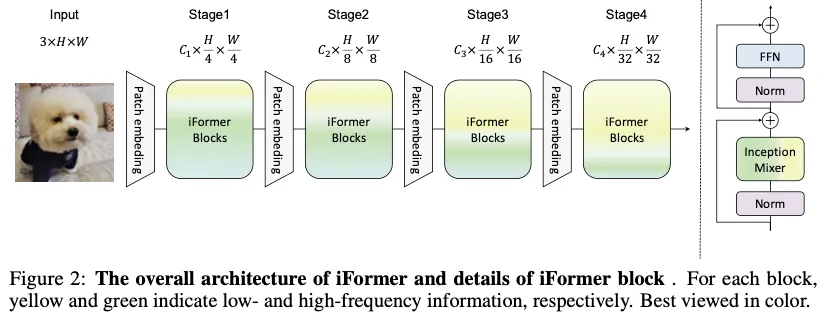
- Given Feature $\mathbf{X} \in \mathbb{R}^{N \times C}$ split it into $\mathbf{X}_h \in \mathbb{R}^{N \times C_h}$ and $\mathbf{X}_l \in \mathbb{R}^{N \times C_l}$
- where $C_h + C_l = C$
- $\mathbf{X}_h$ : High-frequency
- $\mathbf{X}_l$ : Low-frequency
- Divide the input $\mathbf{X}h$ into $\mathbf{X}{h_1} \in \mathbb{R}^{N \times \frac{C_h}{2}}$ and $\mathbf{X}_{h_2} \in \mathbb{R}^{N \times \frac{C_h}{2}}$
High-frequency Mixer

- $\mathbf{Y}{h_1} = \text{FC}(\text{MaxPool}(\mathbf{X}{h_1}))$
- $\mathbf{Y}{h_2} = \text{DwConv}(\text{FC}(\mathbf{X}{h_2}))$
- $\mathbf{Y}_l = \text{Upsample}(\text{MSA}(\text{AvePooling}(\mathbf{X}_l)))$s
- $\mathbf{Y}c = \text{Concat}(\mathbf{Y}l, \mathbf{Y}{h_1}, \mathbf{Y}{h_2})$
- $\mathbf{Y} = \text{FC}(\mathbf{Y}_c + \text{DwConv}(\mathbf{Y}_c))$
- $\mathbf{Y}=\mathbf{X} + \text{ITM}(\text{LN}(\mathbf{X}))$, Inception Token Mixer
- $\mathbf{H}=\mathbf{Y} + \text{ITM}(\text{LN}(\mathbf{Y}))$
Frequency Ramp Sturcture
- Gradually splits more channel dimensions from lower to higher layers to low-frequency mixer
- Leave fewer channel dimensions to high-frequency mixer
$\mathbf{Y}_l = \text{Upsample}(\text{MSA}(\text{AvePooling}(\mathbf{X}_l)))$
Experiment
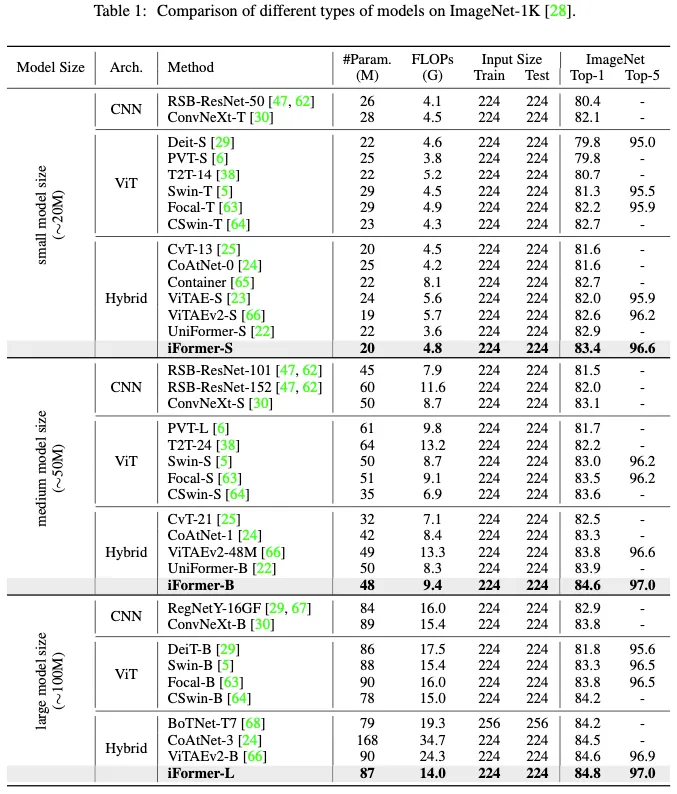

Limitations
- Requires manually defined channel ratio in the frequency ramp structure